
CHEMICAL STORAGE FACILITIES
Intended use
The unit is designed for the central supply of production machinery with liquids delivered in Intermediate Bulk Containers (IBC).
Basic applications
- unloading liquids delivered in IBC containers,
- storage under controlled conditions,
- transfer of liquids to production machinery.
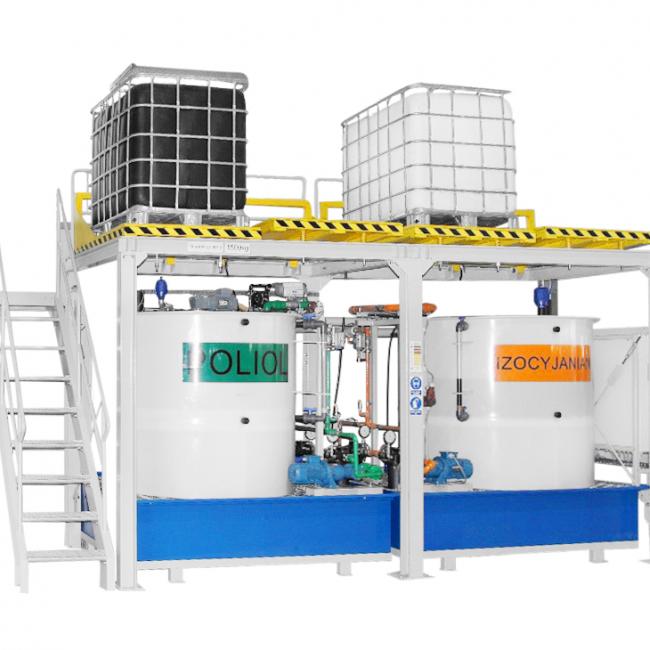
System components
| Operator platform | Allowing easy connection of the drain system to IBC using Camlock quick - couplings; |
| IBC docking | Provided with special, spring - tilted ramps to allow complete draining of IBC; |
| Intermediate tanks | Standard capacity 1500l, made in plastic or steel; |
| Level sensors | Ultrasonic or immersion type to measure the liquid level inside the tank; |
| Drip trays | 120% of capacity of the intermediate tanks; |
| Pumps | Depending of the pumped substance, the system is equipped with screw pumps, gear pumps, membrane pumps,provided with mechanical sealing or hermitcally sealed with magnetic coupling; |
| Filters | Strainers for pumped fluids and air breathers (with water removal) for equalizing intermediate tank pressure; |
| Valves | Operated manually or by pneumatic cylinder, selected idividually based on the applied pressure and pumped medium; |
| Manometers | Vacuum gauges or pressure switches indicating current negative or positive pressure levels in the system; |
| Mixer | Parlicularly for nonhomogeneous liquids, with stepless speed adjustment; |
| PLC control | Machine control and comumunication with other equipment via Siemens S7-1200 controller. Other control system on demand; |
Description of operation
The Intermediate Bulk Containers are placed on the dedicated platform rack. Once the outlet connection is made, the contents flow by gravity into the system. The process is automatically monitored and stopped when the intermediate tank reaches its maximum fill level. An agitator is then activated to ensure the correct consistency and homogeneity of the liquid. In the final stage, the liquid is pumped to the customer’s installation or machine, depending on process requirements.
Benefits
- reduced storage space requirements through the centralised storage of production chemicals,
- improved organisation of the production area, as IBC containers no longer need to be stored next to the machines,
- lower handling and logistics costs,
- minimised risk of chemical leaks, including potential environmental hazards,
- improved personnel safety by reducing direct contact with substances during IBC handling,
- elimination of machine downtime related to raw material replenishment.